Singularity Machine Learning - Classification: Funkcja Qiskit od Multiverse Computing
Zobacz dokumentację API
Wersje pakietów
Kod na tej stronie został opracowany przy użyciu następujących wymagań. Zalecamy użycie tych wersji lub nowszych.
scikit-learn~=1.8.0
- Funkcje Qiskit to funkcja eksperymentalna dostępna wyłącznie dla użytkowników planów IBM Quantum® Premium Plan, Flex Plan oraz On-Prem (za pośrednictwem interfejsu API IBM Quantum Platform). Mają status wersji zapoznawczej i mogą ulec zmianie.
Przegląd
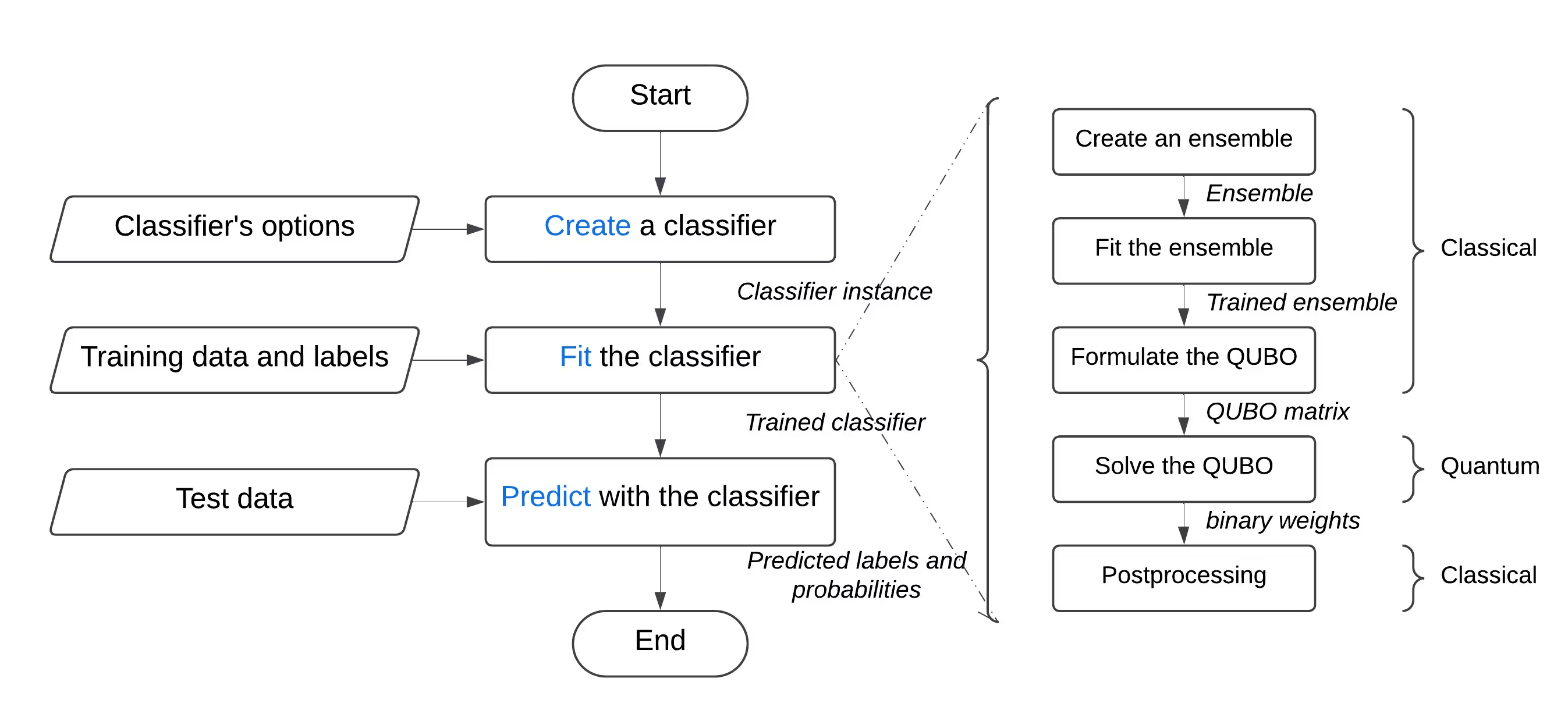
Funkcja „Singularity Machine Learning - Classification" pozwala rozwiązywać rzeczywiste problemy uczenia maszynowego na sprzęcie kwantowym bez konieczności posiadania wiedzy z zakresu informatyki kwantowej. Ta funkcja aplikacyjna, oparta na metodach zespołowych, jest hybrydowym klasyfikatorem. Wykorzystuje klasyczne metody, takie jak boosting, bagging i stacking, do wstępnego trenowania zespołu. Następnie stosuje algorytmy kwantowe — wariacyjny solver własny (VQE) oraz kwantowy algorytm przybliżonej optymalizacji (QAOA) — w celu zwiększenia różnorodności wytrenowanego zespołu, jego zdolności do generalizacji oraz ogólnej złożoności.
W przeciwieństwie do innych rozwiązań z zakresu kwantowego uczenia maszynowego, ta funkcja potrafi obsługiwać wielkoskalowe zbiory danych zawierające miliony przykładów i cech, nie będąc ograniczona liczbą Qubitów w docelowym QPU. Liczba Qubitów określa jedynie rozmiar zespołu, który można wytrenować. Funkcja jest również bardzo elastyczna i może być stosowana do rozwiązywania problemów klasyfikacyjnych w szerokim zakresie dziedzin, w tym finansów, opieki zdrowotnej i cyberbezpieczeństwa.
Konsekwentnie osiąga wysoką dokładność na klasycznie trudnych problemach obejmujących wielowymiarowe, zaszumione i niezrównoważone zbiory danych.
 Przeznaczona jest dla:
- Inżynierów i naukowców zajmujących się danymi w firmach, którzy chcą wzbogacić swoją ofertę technologiczną, integrując kwantowe uczenie maszynowe ze swoimi produktami i usługami,
- Badaczy w laboratoriach badań kwantowych eksplorujących zastosowania kwantowego uczenia maszynowego i pragnących wykorzystać obliczenia kwantowe do zadań klasyfikacyjnych, oraz
- Studentów i nauczycieli w instytucjach edukacyjnych, na kursach takich jak uczenie maszynowe, którzy chcą zademonstrować przewagi obliczeń kwantowych.
Poniższy przykład prezentuje różne funkcjonalności, w tym create, list, fit i predict, oraz demonstruje ich użycie na syntetycznym problemie złożonym z dwóch przeplatających się półokręgów — notorycznie trudnym ze względu na nieliniową granicę decyzyjną.
Opis funkcji
Ta funkcja Qiskit umożliwia użytkownikom rozwiązywanie binarnych problemów klasyfikacyjnych za pomocą kwantowo ulepszonego klasyfikatora zespołowego Singularity. W tle wykorzystuje podejście hybrydowe: klasycznie trenuje zespół klasyfikatorów na oznaczonym zbiorze danych, a następnie optymalizuje go pod kątem maksymalnej różnorodności i generalizacji przy użyciu Kwantowego Algorytmu Przybliżonej Optymalizacji (QAOA) na QPU IBM®. Dzięki przyjaznemu interfejsowi użytkownicy mogą skonfigurować klasyfikator zgodnie ze swoimi wymaganiami, wytrenować go na wybranym zbiorze danych i użyć do przewidywania na wcześniej niewidzianym zbiorze danych.
Aby rozwiązać ogólny problem klasyfikacyjny:
- Przygotuj wstępnie zbiór danych i podziel go na zestawy treningowy i testowy. Opcjonalnie możesz dalej podzielić zestaw treningowy na zestawy treningowy i walidacyjny. Można to osiągnąć za pomocą scikit-learn.
- Jeśli zestaw treningowy jest niezrównoważony, możesz go próbkować ponownie, aby wyrównać klasy, używając imbalanced-learn.
- Prześlij zestawy treningowy, walidacyjny i testowy osobno do magazynu funkcji, używając metody
file_uploadkatalogu i podając odpowiednią ścieżkę za każdym razem. - Zainicjuj klasyfikator kwantowy, używając akcji
createfunkcji, która przyjmuje hiperparametry, takie jak liczba i typy uczących się modeli, regularyzacja (wartość lambda) oraz opcje optymalizacji, w tym liczba warstw, typ klasycznego optymalizatora, Backend kwantowy itd. - Wytrenuj klasyfikator kwantowy na zestawie treningowym, używając akcji
fitfunkcji, podając oznaczony zestaw treningowy i zestaw walidacyjny (jeśli dotyczy). - Wykonaj przewidywania na wcześniej niewidzianym zestawie testowym, używając akcji
predictfunkcji.
Pierwsze kroki
Uwierzytelnij się przy użyciu klucza API IBM Quantum Platform i wybierz funkcję Qiskit w następujący sposób:
# Added by doQumentation — required packages for this notebook
!pip install -q numpy qiskit-ibm-catalog scikit-learn
from qiskit_ibm_catalog import QiskitFunctionsCatalog

catalog = QiskitFunctionsCatalog(channel="ibm_quantum_platform")

# Verify that you have access to the function
catalog.list()
[QiskitFunction(qunova/hivqe-chemistry),
 QiskitFunction(global-data-quantum/quantum-portfolio-optimizer),
 QiskitFunction(algorithmiq/tem),
 QiskitFunction(qedma/qesem),
 QiskitFunction(multiverse/singularity),
 QiskitFunction(ibm/circuit-function),
 QiskitFunction(q-ctrl/optimization-solver),
 QiskitFunction(colibritd/quick-pde),
 QiskitFunction(q-ctrl/performance-management),
 QiskitFunction(kipu-quantum/iskay-quantum-optimizer)]
# load function
singularity = catalog.load("multiverse/singularity")
Przykłady
Klasyfikacja zbioru danych
W tym przykładzie użyjesz funkcji „Singularity Machine Learning - Classification", aby sklasyfikować zbiór danych składający się z dwóch przeplatających się, półkolistych kształtów przypominających księżyce. Zbiór danych jest syntetyczny, dwuwymiarowy i opatrzony binarnymi etykietami. Został stworzony tak, by stanowił wyzwanie dla algorytmów takich jak grupowanie oparte na centroidach czy klasyfikacja liniowa.
 Podczas tego procesu dowiesz się, jak utworzyć klasyfikator, dopasować go do danych treningowych, użyć go do przewidywania na danych testowych oraz usunąć klasyfikator po zakończeniu pracy.
Przed rozpoczęciem musisz zainstalować scikit-learn. Zainstaluj go przy użyciu następującego polecenia:
Podczas tego procesu dowiesz się, jak utworzyć klasyfikator, dopasować go do danych treningowych, użyć go do przewidywania na danych testowych oraz usunąć klasyfikator po zakończeniu pracy.
Przed rozpoczęciem musisz zainstalować scikit-learn. Zainstaluj go przy użyciu następującego polecenia:
python3 -m pip install scikit-learn
Wykonaj następujące kroki:
-
Utwórz syntetyczny zbiór danych przy użyciu funkcji
make_moonsz biblioteki scikit-learn. -
Prześlij wygenerowany syntetyczny zbiór danych do wspólnego katalogu danych.
-
Utwórz klasyfikator wspomagany kwantowo przy użyciu akcji
create. -
Wypisz swoje klasyfikatory przy użyciu akcji
list. -
Wytrenuj klasyfikator na danych treningowych przy użyciu akcji
fit. -
Użyj wytrenowanego klasyfikatora do przewidywania na danych testowych przy użyciu akcji
predict. -
Usuń klasyfikator przy użyciu akcji
delete. -
Posprzątaj po zakończeniu. Krok 1. Zaimportuj niezbędne moduły i wygeneruj syntetyczny zbiór danych, a następnie podziel go na zbiory treningowy i testowy.
# import the necessary modules for this example
import os
import tarfile
import numpy as np

# Import the make_moons and the train_test_split functions from scikit-learn
# to create a synthetic dataset and split it into training and test datasets
from sklearn.datasets import make_moons
from sklearn.model_selection import train_test_split

# generate the synthetic dataset
X, y = make_moons(n_samples=10000)

# split the data into training and test datasets
X_train, X_test, y_train, y_test = train_test_split(X, y, test_size=0.2)

# print the first 10 samples of the training dataset
print("Features:", X_train[:10, :])
print("Targets:", y_train[:10])
Features: [[ 0.84757037 -0.48831433]
 [ 0.98132552  0.19235443]
 [-0.71626723  0.6978261 ]
 [ 1.18957848 -0.48186557]
 [ 0.52118982 -0.37791846]
 [ 0.81115408  0.58483251]
 [ 0.48706462  0.87336593]
 [-0.81880144  0.57407682]
 [ 1.67335408 -0.23932015]
 [ 0.50181306  0.8649761 ]]
Targets: [1 0 0 1 1 0 0 0 1 0]
Krok 2. Zapisz oznaczone zbiory treningowy i testowy na lokalnym dysku, a następnie prześlij je do wspólnego katalogu danych.
def make_tarfile(file_path, tar_file_name):
    with tarfile.open(tar_file_name, "w") as tar:
        tar.add(file_path, arcname=os.path.basename(file_path))

# save the training and test datasets on your local disk
np.save("X_train.npy", X_train)
np.save("y_train.npy", y_train)
np.save("X_test.npy", X_test)
np.save("y_test.npy", y_test)

# create tar files for the datasets
make_tarfile("X_train.npy", "X_train.npy.tar")
make_tarfile("y_train.npy", "y_train.npy.tar")
make_tarfile("X_test.npy", "X_test.npy.tar")
make_tarfile("y_test.npy", "y_test.npy.tar")

# upload the datasets to the shared data directory
catalog.file_upload("X_train.npy.tar", singularity)
catalog.file_upload("y_train.npy.tar", singularity)
catalog.file_upload("X_test.npy.tar", singularity)
catalog.file_upload("y_test.npy.tar", singularity)

# view/enlist the uploaded files in the shared data directory
print(catalog.files(singularity))
['X_test.npy.tar', 'X_train.npy.tar', 'y_test.npy.tar', 'y_train.npy.tar']
Krok 3. Utwórz klasyfikator wspomagany kwantowo przy użyciu akcji create.
job = singularity.run(
    action="create",
    name="my_classifier",
    num_learners=10,
    learners_types=[
        "DecisionTreeClassifier",
        "KNeighborsClassifier",
    ],
    learners_proportions=[0.5, 0.5],
    learners_options=[{}, {}],
    regularization=0.01,
    weight_update_method="logarithmic",
    sample_scaling=True,
    optimizer_options={"simulator": True},
    voting="soft",
    prob_threshold=0.5,
)

print(job.result())
{'status': 'ok', 'message': 'Classifier created.', 'data': {}, 'metadata': {'resource_usage': {}}}
# list available classifiers using the list action
job = singularity.run(action="list")

print(job.result())

# you can also find your classifiers in the shared data directory with a *.pkl.tar extension
print(catalog.files(singularity))
{'status': 'ok', 'message': 'Classifiers listed.', 'data': {'classifiers': ['my_classifier']}, 'metadata': {'resource_usage': {}}}
['X_test.npy.tar', 'X_train.npy.tar', 'my_classifier.pkl.tar', 'y_test.npy.tar', 'y_train.npy.tar']
Krok 4. Wytrenuj klasyfikator wspomagany kwantowo przy użyciu akcji fit.
job = singularity.run(
    action="fit",
    name="my_classifier",
    X="X_train.npy",  # you do not need to specify the tar extension
    y="y_train.npy",  # you do not need to specify the tar extension
)

print(job.result())
{'status': 'ok', 'message': 'Classifier fitted.', 'data': {}, 'metadata': {'resource_usage': {'RUNNING: MAPPING': {'CPU_TIME': 13.655871629714966}, 'RUNNING: WAITING_QPU': {'CPU_TIME': 54.688621282577515}, 'RUNNING: POST_PROCESSING': {'CPU_TIME': 56.92286920547485}, 'RUNNING: EXECUTING_QPU': {'QPU_TIME': 57.92738223075867}}}}
Krok 5. Pobierz predykcje i prawdopodobieństwa z klasyfikatora wspomaganego kwantowo przy użyciu akcji predict.
job = singularity.run(
    action="predict",
    name="my_classifier",
    X="X_test.npy",  # you do not need to specify the tar extension
)

result = job.result()

print("Action result status: ", result["status"])
print("Action result message: ", result["message"])
print("Predictions (first five results):", result["data"]["predictions"][:5])
print(
    "Probabilities (first five results):", result["data"]["probabilities"][:5]
)
Action result status:  ok
Action result message:  Classifier predicted.
Predictions (first five results): [0, 0, 1, 0, 1]
Probabilities (first five results): [[1.0, 0.0], [1.0, 0.0], [0.0, 1.0], [1.0, 0.0], [0.0, 1.0]]
Krok 6. Usuń klasyfikator wspomagany kwantowo przy użyciu akcji delete.
job = singularity.run(
    action="delete",
    name="my_classifier",
)

# or you can delete from the shared data directory
# catalog.file_delete("my_classifier.pkl.tar", singularity)

print(job.result())
{'status': 'ok', 'message': 'Classifier deleted.', 'data': {}, 'metadata': {'resource_usage': {}}}
Krok 7. Wyczyść lokalne i wspólne katalogi danych.
# delete the numpy files from your local disk
os.remove("X_train.npy")
os.remove("y_train.npy")
os.remove("X_test.npy")
os.remove("y_test.npy")

# delete the tar files from your local disk
os.remove("X_train.npy.tar")
os.remove("y_train.npy.tar")
os.remove("X_test.npy.tar")
os.remove("y_test.npy.tar")

# delete the tar files from the shared data
catalog.file_delete("X_train.npy.tar", singularity)
catalog.file_delete("y_train.npy.tar", singularity)
catalog.file_delete("X_test.npy.tar", singularity)
catalog.file_delete("y_test.npy.tar", singularity)
'Requested file was deleted.'
Przykład create_fit_predict
Poniższy przykład demonstruje akcję create_fit_predict.
# Import QiskitFunctionsCatalog to load the
# "Singularity Machine Learning - Classification" function by Multiverse Computing
from qiskit_ibm_catalog import QiskitFunctionsCatalog

# Import the make_moons and the train_test_split functions from scikit-learn
# to create a synthetic dataset and split it into training and test datasets
from sklearn.datasets import make_moons
from sklearn.model_selection import train_test_split

# authentication
# If you have not previously saved your credentials, follow instructions at
# /docs/guides/functions
# to authenticate with your API key.
catalog = QiskitFunctionsCatalog(channel="ibm_quantum_platform")

# load "Singularity Machine Learning - Classification" function by Multiverse Computing
singularity = catalog.load("multiverse/singularity")

# generate the synthetic dataset
X, y = make_moons(n_samples=1000)

# split the data into training and test datasets
X_train, X_test, y_train, y_test = train_test_split(X, y, test_size=0.2)

job = singularity.run(
    action="create_fit_predict",
    num_learners=10,
    regularization=0.01,
    optimizer_options={"simulator": True},
    X_train=X_train,
    y_train=y_train,
    X_test=X_test,
    options={"save": False},
)

# get job status and result
status = job.status()
result = job.result()

print("Job status: ", status)
print("Action result status: ", result["status"])
print("Action result message: ", result["message"])
print("Predictions (first five results): ", result["data"]["predictions"][:5])
print(
    "Probabilities (first five results): ",
    result["data"]["probabilities"][:5],
)
print("Usage metadata: ", result["metadata"]["resource_usage"])
Job status:  QUEUED
Action result status:  ok
Action result message:  Classifier created, fitted, and predicted.
Predictions (first five results):  [0, 0, 1, 0, 0]
Probabilities (first five results):  [[0.87119766531518, 0.1288023346848197], [0.87119766531518, 0.1288023346848197], [0.24470328446479797, 0.7552967155352032], [0.820524432250189, 0.17947556774981072], [0.6847610293419495, 0.31523897065805173]]
Usage metadata:  {'RUNNING: MAPPING': {'CPU_TIME': 10.967791318893433}, 'RUNNING: WAITING_QPU': {'CPU_TIME': 59.91712307929993}, 'RUNNING: POST_PROCESSING': {'CPU_TIME': 59.097386837005615}, 'RUNNING: EXECUTING_QPU': {'QPU_TIME': 56.93338203430176}}
Testy wydajności
Te testy wydajności pokazują, że klasyfikator może osiągać wyjątkowo wysoką dokładność na trudnych problemach. Pokazują one również, że zwiększenie liczby uczniów w zespole (liczby Qubitów) może prowadzić do wzrostu dokładności.
„Dokładność klasyczna" odnosi się do dokładności uzyskanej przy użyciu odpowiedniego klasycznego modelu najnowszej generacji, którym w tym przypadku jest klasyfikator AdaBoost oparty na zespole o rozmiarze 75. „Dokładność kwantowa" natomiast odnosi się do dokładności uzyskanej przy użyciu „Singularity Machine Learning - Classification".
| Problem | Rozmiar zbioru danych | Rozmiar zespołu | Liczba Qubitów | Dokładność klasyczna | Dokładność kwantowa | Poprawa |
|---|---|---|---|---|---|---|
| Stabilność sieci | 5000 przykładów, 12 cech | 55 | 55 | 76% | 91% | 15% |
| Stabilność sieci | 5000 przykładów, 12 cech | 65 | 65 | 76% | 92% | 16% |
| Stabilność sieci | 5000 przykładów, 12 cech | 75 | 75 | 76% | 94% | 18% |
| Stabilność sieci | 5000 przykładów, 12 cech | 85 | 85 | 76% | 94% | 18% |
| Stabilność sieci | 5000 przykładów, 12 cech | 100 | 100 | 76% | 95% | 19% |
W miarę jak sprzęt kwantowy ewoluuje i skaluje się, implikacje dla naszego klasyfikatora kwantowego stają się coraz bardziej znaczące. Choć liczba Qubitów narzuca ograniczenia na rozmiar zespołu, który można wykorzystać, nie ogranicza ona wolumenu danych, jakie można przetwarzać. Ta potężna właściwość umożliwia klasyfikatorowi efektywne obsługiwanie zbiorów danych zawierających miliony punktów danych i tysiące cech. Co istotne, ograniczenia związane z rozmiarem zespołu można rozwiązać poprzez implementację wersji klasyfikatora na dużą skalę. Dzięki zastosowaniu iteracyjnego podejścia z zewnętrzną pętlą zespół może być dynamicznie rozszerzany, co zwiększa elastyczność i ogólną wydajność. Warto jednak zauważyć, że ta funkcja nie została jeszcze zaimplementowana w bieżącej wersji klasyfikatora.
Dziennik zmian
4 czerwca 2025
-
Zaktualizowano
QuantumEnhancedEnsembleClassifiero następujące zmiany:-
Dodano regularyzację onsite/alpha. Możesz określić
regularization_typejakoonsitelubalpha -
Dodano automatyczną regularyzację. Możesz ustawić
regularizationnaauto, aby używać automatycznej regularyzacji -
Dodano parametr
optimization_datado metodyfit, umożliwiający wybór danych optymalizacyjnych dla optymalizacji kwantowej. Możesz użyć jednej z tych opcji:train,validationlubboth -
Poprawiono ogólną wydajność
-
-
Dodano szczegółowe śledzenie statusu dla uruchomionych zadań
20 maja 2025
- Ujednolicono obsługę błędów
18 marca 2025
- Zaktualizowano qiskit-serverless do wersji 0.20.0 i obraz bazowy do 0.20.1
14 lutego 2025
- Zaktualizowano obraz bazowy do wersji 0.19.1
6 lutego 2025
- Zaktualizowano qiskit-serverless do wersji 0.19.0 i obraz bazowy do 0.19.0
13 listopada 2024
- Wydanie Singularity Machine Learning - Classification
Uzyskaj wsparcie
W przypadku jakichkolwiek pytań skontaktuj się z Multiverse Computing.
Pamiętaj, aby dołączyć następujące informacje:
-
ID zadania Qiskit Function (
job.job_id) -
Szczegółowy opis problemu
-
Wszelkie istotne komunikaty lub kody błędów
-
Kroki do odtworzenia problemu
Następne kroki
-
Poproś o dostęp do funkcji Singularity Machine Learning Classification firmy Multiverse Computing.
-
Odwiedź dokumentację API tej funkcji Qiskit.
-
Zapoznaj się z Leclerc, L., et al. (2023). Financial risk management on a neutral atom quantum processor. Physical Review Research, 5, 043117.